


The underlying need for screening solutions
Across Europe, construction remains one of the largest generators of waste, accounting for over one-third of total EU waste streams. Despite this volume, recovery rates remain limited, with only around around 40-45% of construction and demolition waste being recycled in the EU, depending on reporting method.
The core issue is not volume, but fragmentation. Materials are still commonly mixed at source, transported long distances, and processed in centralized facilities. This increases handling stages, fuel consumption per tonne, and can reduce material quality through repeated mixing.
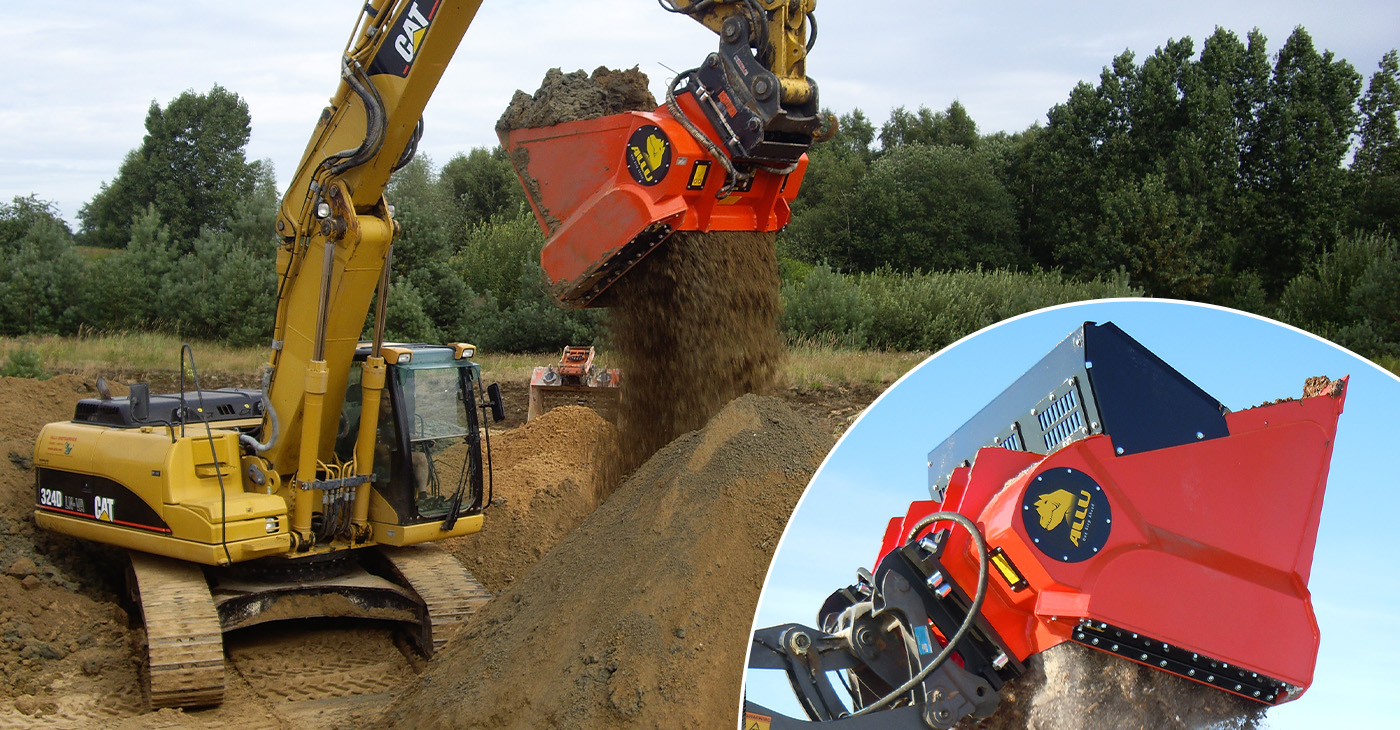
On-site processing with excavator screener bucket systems
By moving separation and classification into the excavation phase itself, the screener bucket helps reduce this structural inefficiency. Instead of treating screening as a downstream process, material is handled immediately during excavation or loading.
Operational workflow changes
Direct material classification
Fractions are separated at source, improving consistency and reducing cross-contamination.
Immediate reuse loops
Suitable material can be reintegrated directly into the project, reducing reliance on imported aggregates.
Reduced logistical complexity
Fewer transport cycles and external processing requirements simplify site coordination.
System-level productivity logic
Traditional metrics like tonnes per hour or cycle time measure output within a single machine. They do not capture inefficiencies across the full material handling workflow. With on-site screening, productivity is defined by reduced process steps. Eliminating transport, re-handling, and secondary processing stages reduces total effort per tonne, not just processing time.
Where system efficiency is highest
Screening bucket systems are most effective where material variability increases processing complexity. In mixed or contaminated material streams, traditional workflows require multiple handling and sorting stages to produce usable fractions. Integrating screening into the excavation process reduces this dependency and stabilizes material quality at the source.
Typical high-value applications include construction and demolition waste, variable soil conditions, forestry residues, industrial by-products such as slag, and organic or biomass-based fractions.
Application guideline
- If your workflow involves multiple handling steps before material becomes usable, a screening bucket system will typically reduce total cost and complexity.
- If material is already uniform and processed at scale, centralized plants may remain more efficient.
Case example: ALLU Transformer system
The Nordic manufacturer ALLU illustrates this shift toward integrated processing with their Transformer systems — hydraulic attachments designed to turn standard excavators and loaders into mobile processing units. This shifts the function from screening to material transformation within the excavation process.
The core technology uses rotating screening shafts with interchangeable configurations, allowing the same attachment to adapt to different material behaviors. In practice, this enables efficient processing of soils, demolition waste, aggregates, and biomass without transferring material to stationary plants.
ALLU product structure and system range
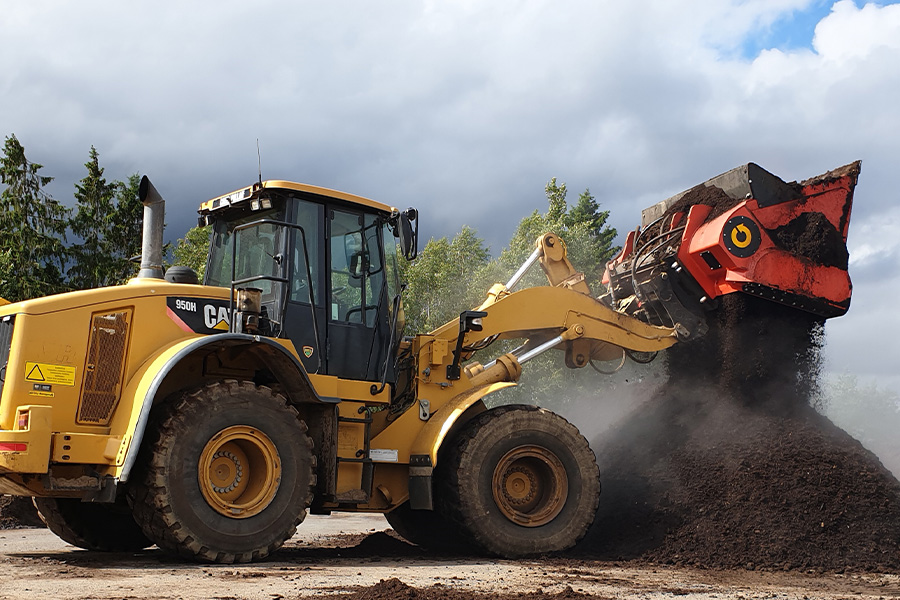
To address different machine sizes and application demands, the system is structured into three main product lines.
Veloci Series
For compact machines and smaller job sites, the Veloci screening bucket enables efficient on-site screening and material separation in lighter applications.
D-Series (Transformer)
This category presents the core multi-purpose system, combining screening, crushing, mixing, and loading in one attachment through configurable drum and blade setups.
M-Series
For high-volume and demanding environments, the M-Series is designed for heavy-duty and large-scale material processing, including mining-grade applications with large excavators and loaders.
Excavation workflow integration with ALLU screener bucket
On-site material transformation
Material is processed immediately at the point of excavation, allowing separation, refinement, and reuse without relocation to fixed plants.
Process flexibility through adjustable screening
The same attachment can be configured for different material streams, from fine soil separation to coarser demolition fractions, without changing equipment.
Consolidated machine footprint
Multiple processing stages (loading, screening, pre-crushing in some applications, and handling) can be replaced by a single excavator-based workflow, reducing equipment spread on site.
Economic impact: the true cost centers
In construction and demolition workflows, transport, handling, and external processing are typically major cost drivers due to fuel consumption, logistics coordination, and processing infrastructure requirements.

The next phase: digitized material handling
The future of material processing is becoming more data-driven. Waste and recycling systems are moving toward greater traceability, optimization, and real-time decision-making. This shift is supported by broader EU digitalization initiatives in resource management. In this context, a screening bucket for excavators becomes part of a larger operational feedback loop. Material data generated during processing can directly inform operational decisions on-site.
Final takeaways – why an excavator screener bucket can drive business growth
1. Greater operational autonomy
Process material at the source and reduce reliance on external plants, transport schedules, and third-party constraints.
2. Lower total cost per tonne
Eliminate transport, re-handling, and disposal steps to reduce overall processing cost—not just machine time.
3. Expanded capability without added complexity
Handle multiple material types with one machine setup, increasing project scope without growing fleet or coordination effort.
4. Faster project execution
Reduce handling stages and waiting times to shorten project timelines and improve site throughput.
5. Improved material utilization
Recover and reuse more material on-site, reducing dependence on virgin resources and improving overall yield.
For a closer look at ALLU’s full product range, visit their global website at https://allu.net/.
